
Five names, one idea, and a great many pitches. AEO, GEO, AI SEO, LLMO and AI visibility all describe trying to show up when someone asks an AI assistant a question. This page gives each term in a sentence, says where it came from, answers whether the words mean different things, quotes what Google and Bing say, and ends with the one thing you can measure under any of them.
What is answer engine optimization?
Answer engine optimization, or AEO, is the work of shaping a page so that an AI assistant picks it as the source of its answer. An answer engine is any system that replies with an answer rather than a list of links, such as ChatGPT, Perplexity, Gemini, Copilot or Google’s AI Overviews.
Generative engine optimization, or GEO, is the same idea as named by researchers in 2023. AI SEO and LLMO are trade names for the same work. AI visibility is the measurement of whether it worked.
| Term | What it means | Where it came from |
|---|---|---|
| AEO | Being picked as the source of a direct answer | Snippets and voice, mid 2010s. Reused for AI from 2024 |
| GEO | Being cited inside an AI-written answer | A research paper, November 2023 |
| AI SEO | The umbrella term marketers use | Trade usage, 2024 onward |
| LLMO | GEO with a more technical name | Trade usage, 2024 onward |
| AI visibility | A measurement, not a practice | Tool vendors, 2025 onward |
If you only want to know which word to use, pick the one your readers or clients already use and keep to it. The sections below explain why that is the honest answer.
Answer engine optimization, AEO
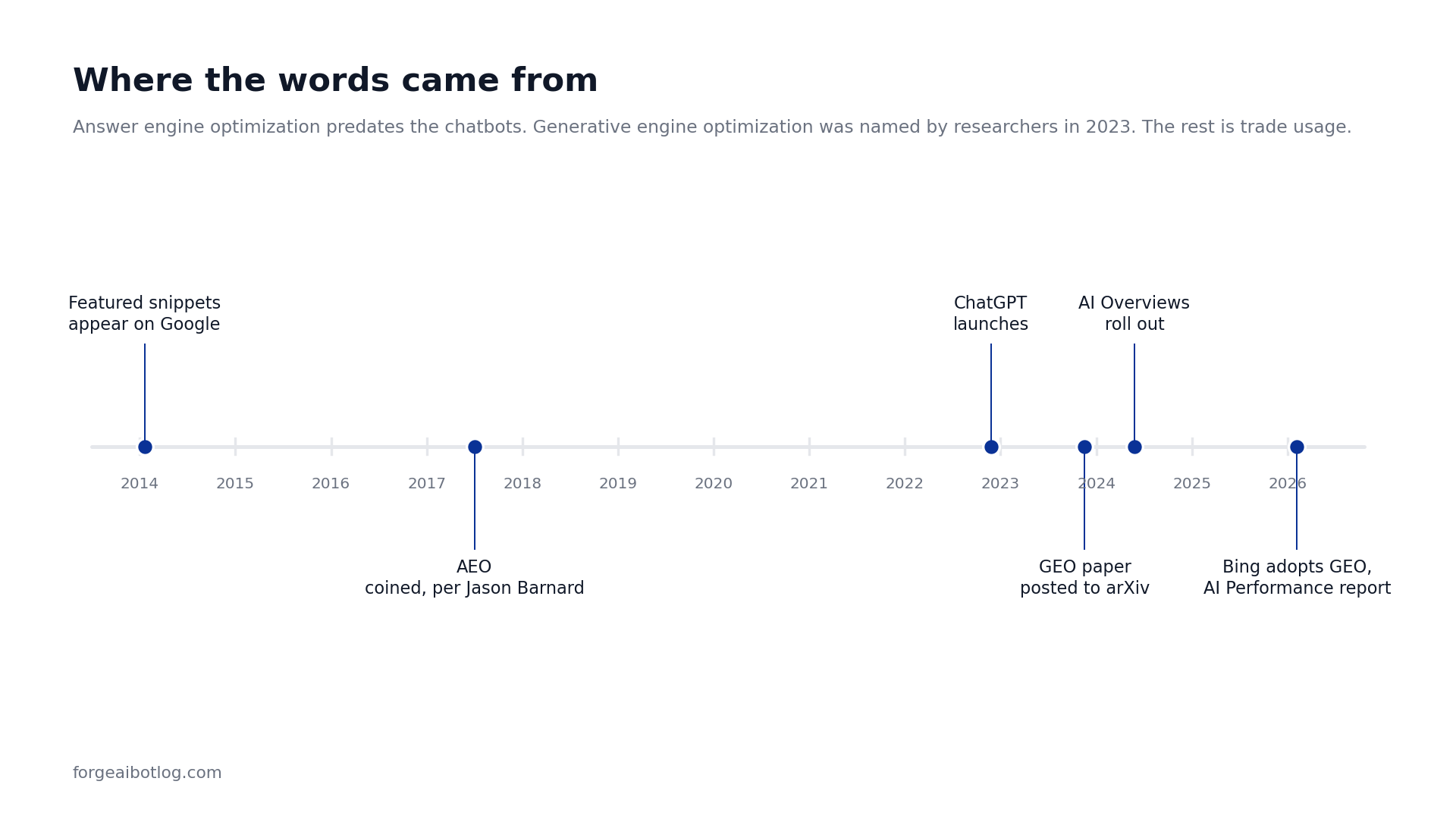
An answer engine is anything that responds to a question with an answer instead of ten links. Google’s featured snippets, the answer box at the top of a results page, began in January 2014 and were the first at scale. Voice assistants such as Siri and Alexa were the next, since a speaker can only read out one answer. ChatGPT, Perplexity, Gemini, Copilot and Google’s AI Overviews and AI Mode are the current ones.
The term is older than the chatbots. Jason Barnard, a search consultant, says he coined it in 2017 as snippets and direct answers began pushing the blue links down the page. His company’s page defines it as “the discipline of structuring content so that answer engines retrieve, trust, and use it as the source of the direct answer to a user query.” The earliest independent record we found is a February 2018 Search Engine Watch article quoting him.
The label reached everyday marketing talk in 2024 and 2025, when ChatGPT and AI Overviews gave it a second life. Note that the three letters also stand for a clothing retailer’s stock ticker and a customs status, which matters when you search for them.
Three definitions, side by side
What the word means now depends on who is using it. Profound, an AI visibility analytics company, defines AEO as “the practice of structuring and formatting content so AI-powered tools like ChatGPT, Perplexity, Google AI Overviews, and voice assistants can easily understand, trust, and cite it as direct answers to user queries.”
HubSpot defines it as “the practice of improving how often and how accurately your business appears in AI-generated answers on AI engines like ChatGPT, Gemini, and Perplexity.” Semrush, in April 2026, called it “a set of marketing practices used to increase your brand’s visibility in AI-generated answers” and did not mention GEO on the page at all.
All three are reasonable. One is about the page, two are about the brand, and none mentions snippets or voice. That drift, from being the answer on a results page to being named inside a chatbot’s reply, is the whole recent history of the term.
What the work usually involves
The tactics vendors describe under AEO are much the same from page to page. Answer the question in the first paragraph. Use headings that match how people ask. Add structured data so machines can read the page. Cite sources, publish original figures, and earn mentions on other sites so the assistants meet your name elsewhere. Some add llms.txt files or markdown copies. Google’s own position on all of this, quoted below, is that none of it is a separate requirement, and the logs our plugin keeps on our own sites agree on the last two.
What is generative engine optimization?
GEO has a birthday. On 16 November 2023 six researchers, then at Princeton, Georgia Tech, the Allen Institute for AI and IIT Delhi, posted a paper titled GEO: Generative Engine Optimization to arXiv, the open archive for research papers, and later presented it at the KDD 2024 conference. The paper’s summary describes GEO as “the first novel paradigm to aid content creators in improving their content visibility in generative engine responses,” built a benchmark of 10,000 questions, and reports that the techniques “can boost visibility by up to 40% in generative engine responses.”
Read that 40 percent carefully. It was measured in a generative engine the researchers built for the experiment, from Google’s top five results and an OpenAI model. Visibility in the paper means how much of the answer is drawn from your page and where it sits, plus a score a model gave for impression, not clicks or traffic. A smaller test on Perplexity showed gains in the same direction. Nothing was tested on ChatGPT, Google’s AI Overviews or Bing.
The techniques that worked best were adding citations, quotations and statistics to a page, which is to say making it look more like a source. The results varied a lot by subject.
One trap. In older SEO writing “geo” means geographic, as in local search, and a search for “geo seo” still returns both meanings. If a proposal says GEO, check which one it means.
AI SEO, AI search optimization, LLMO and AI visibility
AI SEO is the plain umbrella. Marketers use it for anything done to appear in AI answers, and it is the most searched of the long names. AI search optimization is the same phrase spelled out. LLMO, large language model optimization, is GEO with a more technical name, used by people who want to sound closer to the machinery. AIO, AI optimization, appears now and then and means the same thing again.
AI visibility is different in kind. It is not a practice but a measurement, usually a score from a tool that asks assistants a list of questions and counts how often you are named or linked. Our guide to tracking AI visibility explains why such a score is a sample rather than a count.
Do the words mean different things?
Not in practice. The pages that use them describe the same work, and the trade itself says so. Profound has a whole post titled AEO vs. GEO: Why they’re the same thing, and prefers AEO partly because GEO clashes with geography. Wikipedia’s entry on generative engine optimization notes that no agreed definition separating the terms had been established in the academic literature as of early 2026.
On paper there is a shade of difference, AEO being about becoming the one answer and GEO about being one of the sources in a longer generated reply, but nobody’s tactics change because of it.
The platforms have picked sides in the naming, which is worth knowing. Google says it is SEO. Microsoft used GEO when it launched the AI Performance report in Bing Webmaster Tools in February 2026 and, as Search Engine Journal reported later that month, has written it into its guidelines. The researchers said GEO. Most of the tool vendors say AEO. When a proposal uses any of them, three questions settle what is actually on offer.
- Which assistants does it cover? Google’s AI Overviews, ChatGPT and Perplexity behave differently and are measured differently.
- What will be measured? A visibility score, a citation count and a visitor count are three different things.
- Which of the tactics is not already good SEO? The answer is usually short.
What Google says about all of them
Google treats the whole subject as SEO. Its page on AI features, last updated in December 2025, says “There are no additional requirements to appear in AI Overviews or AI Mode, nor other special optimizations necessary.” Its guide to the subject, updated in July 2026, says the usual SEO practices still apply because its AI features are built on its core ranking systems, and recommends useful original content and a clean technical structure.
The same guide says there is no need to break content into small pieces or to write in a special way for AI. It says seeking inauthentic mentions around the web is less helpful than it might seem. And it says llms.txt files bring “neither harm nor help” because Google Search ignores them. It adds a warning worth keeping. “No third-party tool has access to our internal ranking or AI systems.”
That covers Google. Microsoft publishes a report of what Copilot and Bing’s AI answers did with your pages, through Bing Webmaster Tools, and our article on what you can know about the prompts behind AI visits explains how to read it. OpenAI, Anthropic and Perplexity publish which bots they run and how to block them, and nothing about optimising for them.
What people are actually searching for
We pulled Semrush’s estimate of monthly United States searches for each term on 25 September 2026, with its twelve-month trend to August. The trend is relative to each term’s busiest month, so a rise from 0.16 to 1.00 means the term is searched about six times as often as it was a year ago.
| Search term | US searches a month | Trend over the year |
|---|---|---|
| AI SEO | 9,900 | Peaked mid year |
| generative engine optimization | 8,100 | Near peak all year |
| answer engine optimization | 4,400 | About 6 times a year ago |
| AI search optimization | 3,600 | Rising |
| AI visibility | 2,900 | About 12 times a year ago |
| LLMO | 1,000 | Flat |
| what is answer engine optimization | 590 | About 8 times a year ago |
The three-letter versions are searched more, but “AEO” also belongs to a retailer and a customs status and “geo seo” to local search, so we have left them out. Two patterns stand out. The long names are searched far more often than their definitions, so most people typing them already know roughly what they mean. And the two terms rising fastest, answer engine optimization and AI visibility, are the two the tool vendors use most.
Common questions
Is AEO the same as SEO?
Google says yes for its own AI features, since they are built on its search ranking. For ChatGPT, Perplexity and Claude the aims overlap heavily, because their fetchers read the same HTML Google does, but nobody outside those companies knows their ranking rules.
Is AEO the same as GEO?
Nearly. GEO came from a 2023 paper about generated answers. AEO is older and once meant snippets and voice. Today most people use them for the same work, one of the biggest vendors says they are the same thing, and no agreed definition separates them.
What is AI SEO?
The everyday umbrella term for all of the above. It is the most searched of the long names, so if you want to be understood by the most people, use it. If you want to be precise, name the assistant and the measure you mean instead.
Is answer engine optimization worth doing?
The parts that overlap with good SEO, clear pages, real sources, plain structure, are worth doing anyway. The parts sold as special, such as llms.txt or markdown copies, have not shown up in our logs as things the big assistants ask for. Our articles on llms.txt and on markdown for AI crawlers have the counts.
What you can measure under any name
Whatever the label, an assistant does three things with your page, and only some can be seen. It fetches the page, which your server records. It cites the page in an answer, which happens on the assistant’s screen and nowhere you can look. And sometimes a person clicks, which your analytics may record if the click carries a referrer. Our article on whether ChatGPT is using your website covers the three, and the one on tracking AI Overviews traffic explains why Google’s clicks cannot be told apart from ordinary search.
So three things to do, whichever word you use.
- Pick one word and use it in every document, so nobody on your side is arguing about labels.
- Count the live reads by assistants’ fetchers and the people they sent, from your own server. Those are the only numbers that describe your site rather than a sample.
- Treat any visibility score as a comparison tool, useful against a competitor on the same day, and nothing more.
Count what the assistants do with your site
The free plugin records every AI bot visit that reaches your WordPress site, sorted into live reads, search crawls and training crawls. Pro adds the people each assistant sent. Whichever word you use for the work, this is the number that shows whether it worked.